
ServiceTitan Capacity Planning: How to Fix Your Scheduling Visibility Problem
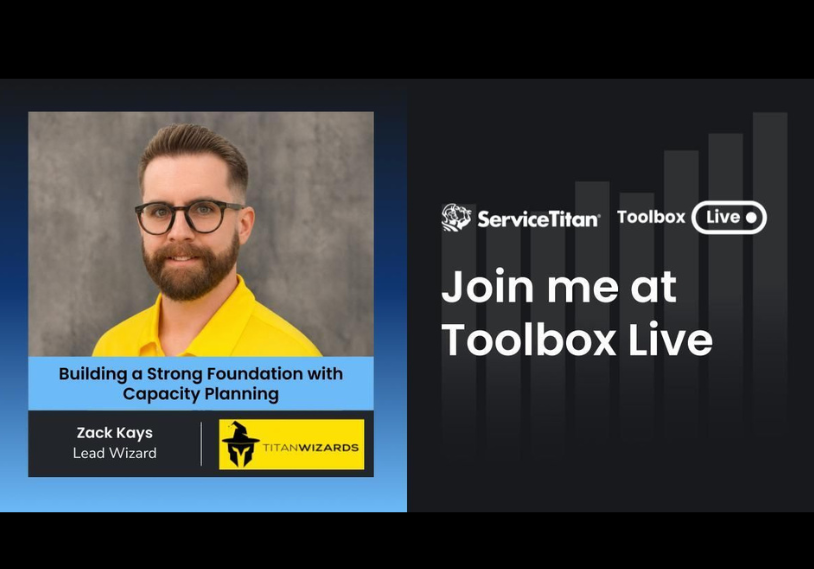
Zack Kays, Lead Titan Wizard, presents "Building a Strong Foundation with Capacity Planning" at ServiceTitan Toolbox Live
Quick answer:ServiceTitan capacity planning is the real-time alignment of technician hours, scheduled work, and available capacity — built through four configuration foundations: Shifts, Zones, Skills, and Business Units. Home service businesses that configure these correctly can book jobs in seconds instead of minutes, without hiring additional technicians.
Titan Wizards, a ServiceTitan consulting firm, is bringing this exact framework to ServiceTitan Toolbox Live next week, where our Lead Titan Wizard, Zack Kays, is speaking on "Building a Strong Foundation with Capacity Planning."
Why Most "Scheduling Problems" Are Actually Visibility Problems
If you run a home service business, you've lived this moment: a customer calls in ready to book, and your CSR has to put them on hold to "check with dispatch." By the time an answer comes back, the customer has lost patience — or booked with a competitor instead.
This isn't usually a lack of capacity. It's a lack of visibility into capacity that already exists. Your team has the technician hours available; they just can't see it in the moment the phone rings. That few seconds of hesitation costs bookings, trust, and revenue every day.
What Is ServiceTitan Capacity Planning?
Capacity planning inside ServiceTitan is the real-time alignment of three variables:
Technician hours — total labor available across your team
Scheduled work — jobs already committed on the calendar
Available capacity — open time ready to book new customers
When these three are synced correctly in your ServiceTitan account, a CSR can book a job in seconds, not minutes — because the system shows exactly who's free, where, and for what type of work.
Every Home Service Shop Already Does Capacity Planning — The Question Is How
Most shops manage capacity one of three ways:
In someone's head
This method works great — until that person takes PTO or leaves the company.
On a whiteboard
The original scheduling software. Erases itself occasionally.
In ServiceTitan
Available 24/7. Doesn't take vacation. Scales as you grow.
Only one of these methods scales with your business.
The Four Foundations of ServiceTitan Capacity Planning
Getting real-time capacity visibility right comes down to configuring four things correctly in your ServiceTitan account:
Shifts — When. When each technician is actually available to work. Bad shift data leads to bad availability — your team can't book what the system can't see.
Zones — Where. Where each technician is assigned to work. Without zone logic, technicians cross town for jobs a neighbor could easily handle.
Skills — What. What jobs each technician is qualified to perform. Skill mismatches create callbacks, rework, and lost revenue.
Business Units — How. How work is categorized across your operation. HVAC, plumbing, and electrical divisions each need their own configured view.
Get these four foundations right, and scheduling, dispatching, and customer experience all improve downstream — without adding headcount.
The ROI of Getting Capacity Planning Right
Small changes at the booking stage compound fast. In shops that implement proper ServiceTitan capacity planning, the typical before-and-after looks like this:
Before: Customer calls → CSR checks the board → CSR calls dispatch → customer waits, often hangs up.
After: Customer calls → CSR sees real-time availability → job is booked instantly → customer stays confident and happy.
That shift can save roughly 25 seconds per call, which adds up across a typical volume of 100+ calls per day — recovering 40+ minutes of CSR time daily that would otherwise be lost to back-and-forth with dispatch.
Frequently Asked Questions
What is capacity planning in ServiceTitan? ServiceTitan capacity planning is the process of aligning technician hours, scheduled jobs, and open availability in real time, using ServiceTitan's Shifts, Zones, Skills, and Business Units settings, so CSRs can book jobs instantly with accurate visibility into who's available.
How do I improve technician utilization in ServiceTitan? Technician utilization improves most reliably by correctly configuring the four capacity foundations — Shifts, Zones, Skills, and Business Units — rather than by adding headcount. Misconfigured shift or zone data is the most common cause of low utilization and inaccurate scheduling.
Do I need a ServiceTitan consultant for capacity planning? Many home service businesses already have the ServiceTitan licenses needed for capacity planning but haven't configured Shifts, Zones, Skills, and Business Units correctly. A ServiceTitan consultant can audit your existing setup and identify gaps without requiring new software spend.
What's the difference between scheduling and capacity planning in ServiceTitan? Scheduling is the day-to-day act of placing jobs on the calendar. Capacity planning is the underlying configuration — technician availability, geography, skills, and business unit structure — that makes scheduling accurate in the first place. Get capacity planning right, and scheduling becomes largely self-correcting.
Catch This Topic Live at Toolbox Live
If you're attending ServiceTitan Toolbox Live, our Lead Titan Wizard Zack Kays is walking through this entire framework live: "Building a Strong Foundation with Capacity Planning." As Zack puts it, "Capacity planning turns scheduling from a daily activity into a strategic business process."
Find us at the event, or contact Titan Wizards if you want a capacity planning audit for your own ServiceTitan account.
Titan Wizards is a ServiceTitan consulting firm helping home service businesses turn their software into a scalable, profitable system. Learn more about our ServiceTitan consulting services or get in touch.
